 Skip to content
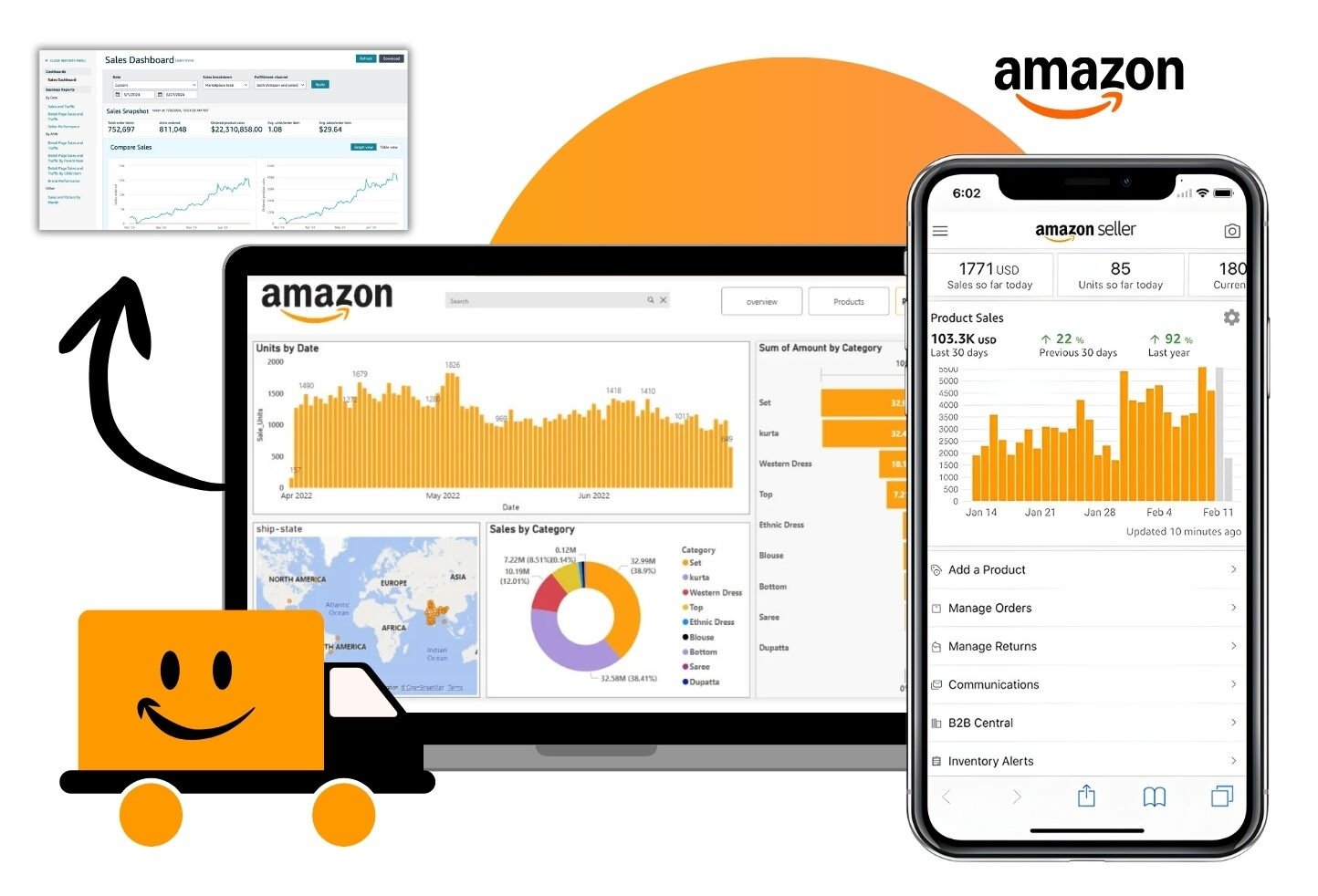
Can I Start Selling on Amazon With $500?
If you are wondering whether $500 is enough to start selling on Amazon, the honest answer is yes, but only if you start lean, choose the right model, and stay realistic about what $500 can actually do. It can be enough to open an Amazon seller account, test a small product idea, buy limited starter inventory, and begin learning how Amazon selling works. What it usually cannot do is fund a big private-label launch, deep inventory, aggressive advertising, and all the backup cash a larger store needs. Amazon says sellers can choose between an Individual plan at $0.99 per item sold and a Professional plan at $39.99 per month, but those plan fees are only part of the full cost picture. Referral fees apply per sale, and optional services such as FBA, advertising, or other growth tools can add meaningful costs.
That matters because Amazon is still a very real business opportunity. Amazon says independent sellers now account for more than 60% of all sales in Amazon’s store, and its seller resources highlight that U.S. independent sellers averaged more than $290,000 in annual sales in 2024. That does not mean every beginner will see anything close to that number. It simply shows that the marketplace is large, active, and full of opportunity when a store is managed correctly.
For most beginners in the USA, the smarter question is not just “Can I start with $500?” but “What is the safest and most practical way to use that $500?” That is where strategy matters. A tight budget leaves very little room for bad product selection, weak listings, poor pricing, or inventory mistakes. It also explains why many new sellers look for structured support through services like Amazon Store Management, Amazon Automation, or the best Amazon Automation Services in the USA, especially when they want to reduce trial-and-error and protect limited capital. SellerCore’s website positions the company around fully managed store operations, product research, listings, pricing, order flow, and long-term digital asset growth for USA-focused sellers and investors.
Is $500 Enough to Start Selling on Amazon?
Yes, $500 can be enough to start selling on Amazon, but it is usually enough for a small, lean launch, not a big brand buildout. With that kind of budget, the most realistic approach is to keep costs low, choose only a few products, watch fees carefully, and avoid tying up too much cash in inventory too early. Amazon’s own pricing pages make it clear that sellers must account for plan fees, referral fees, and optional program costs, while its FBA resources explain that fulfillment and storage can add more expense depending on the product, size, weight, and inventory volume.
In other words, $500 is a starting budget, not a comfort budget. It can help you test, learn, and launch. It is rarely enough to build a fully scaled Amazon business without disciplined execution. That is an inference from Amazon’s fee structure and optional service model, not a fixed rule, but it is the most realistic way to think about the budget.
What Amazon Actually Charges New Sellers
One reason beginners struggle with budget planning is that they often think Amazon selling has one cost. It does not. Amazon says there are two basic selling plans: the Individual plan, which charges $0.99 per item sold, and the Professional plan, which charges $39.99 per month. In addition to the selling plan, Amazon charges a referral fee on each item sold, and optional services such as advertising, Vine, promotions, and FBA can create additional costs.
If you use Fulfillment by Amazon (FBA), Amazon says it will store, pick, pack, and ship customer orders and also handle returns and customer service. That convenience can save time and reduce operational friction, but it comes with additional cost layers. Amazon’s own fee explanations mention FBA fulfillment fees, monthly storage fees, and potentially other inventory-related costs depending on the product and how long inventory sits in Amazon’s network.
That is why a $500 launch works best when you think like a capital allocator, not like a hype buyer. You need to know where the money is going before you ever upload a listing. Amazon itself offers a Revenue Calculator specifically so sellers can preview fees, compare FBA with self-fulfillment, and estimate revenue before they commit.
What a $500 Amazon Startup Budget Should Really Cover
A realistic $500 Amazon launch budget is less about chasing a “perfect” number and more about protecting cash flow. In practice, that money usually needs to cover some combination of your selling plan, sample orders or first inventory, product prep or packaging, shipping, basic branding or listing work, and a small buffer for unexpected costs. Because Amazon’s fees vary by category, size, weight, and fulfillment method, the exact split will depend on the product you choose. Amazon’s fee tools make that very clear.
A lean beginner budget often works better like this: keep the account cost low, test one small product idea or a very small catalog, avoid overbuying inventory, and reserve cash for the first few weeks of operating friction. That friction can come from slow sales, fee surprises, returns, shipping adjustments, or the need to restock sooner than expected. The tighter the starting budget, the more important operational discipline becomes. That is exactly why services built around Product Research & Listings, Pricing & Inventory Management, and Order Processing & Fulfillment become especially relevant for new sellers. SellerCore’s homepage and About pages emphasize those functions as part of its managed system.
The Best Amazon Selling Models for a $500 Budget
Not every Amazon business model fits a $500 launch.
The best low-budget path is usually the one that keeps your upfront inventory exposure low and your learning speed high. For many beginners, that means starting with a small product test rather than trying to build a large private-label brand from day one. Amazon’s beginner content encourages sellers to start by creating a good shopping experience, learning the platform, and building the business step by step rather than overcomplicating the launch. Amazon also notes that sellers can reach customers in 100+ countries, which makes the opportunity real, but it does not remove the need for careful execution.
A $500 budget is generally more realistic for:
- a very small inventory test,
- a simple, focused product catalog,
- self-fulfillment or carefully costed FBA,
- a beginner learning phase where the goal is proof of concept, not instant scale.
A $500 budget is generally less realistic for:
- a full private-label launch with deep inventory,
- aggressive ad spending,
- multiple SKUs at once,
- a high-cash-burn strategy that assumes fast sales before the data exists.
Those conclusions follow from Amazon’s fee structure, optional service costs, and the way FBA and inventory charges can grow as operations become more complex.
Should You Use the Individual Plan or the Professional Plan?
This is one of the biggest beginner decisions.
If your budget is only $500, the Individual plan may feel safer because it avoids the fixed $39.99 monthly Professional fee and instead charges $0.99 per item sold. That can help protect cash while you are still testing whether the product is viable. Amazon’s own plan comparison makes that tradeoff very clear.
However, the Professional plan becomes more appealing when you want access to more advanced tools and a more serious growth setup. Amazon’s pricing page says the Professional plan includes access to hundreds of tools and programs, and Amazon’s New Seller Guide content highlights that several growth features are tied to Professional selling. So the right choice depends on whether your first goal is capital preservation or faster scaling infrastructure.
For a strict $500 beginner budget, many sellers are better off starting lean and moving into more advanced tooling once they confirm product demand and cash flow. That is an operating recommendation based on Amazon’s published plan structure and optional program costs.
Can I Start Selling on Amazon With $500 in 2026 FBA?
Yes, but carefully.
Amazon says FBA can handle storage, picking, packing, shipping, customer service, and returns, which is why so many sellers want to use it. It can make the business feel more automated and operationally manageable, especially when time matters.
But on a $500 budget, FBA can also squeeze your cash faster because the seller must still account for inventory purchase cost, referral fees, fulfillment fees, storage fees, and possible inventory-related charges if stock moves slowly. Amazon’s own fee guides and inventory materials point out that too much or poorly managed inventory can hurt the bottom line.
That means FBA with $500 is possible, but it works best when you keep inventory tight, choose a product with simple dimensions and manageable fees, and use Amazon’s Revenue Calculator before buying anything. If you skip the cost modeling step, $500 can disappear faster than most beginners expect.
What Usually Goes Wrong When Beginners Start With Only $500
The biggest problem is not always the budget. It is often the way the budget is used.
Many new sellers spend too much too early on the wrong product. Others underestimate referral fees, fulfillment costs, storage, prep work, or the time it takes to get a listing right. Some beginners assume one product will sell immediately, then discover that weak research, low conversion, or slow replenishment ties up their limited cash. Amazon’s own tools around pricing, fee estimation, and inventory performance exist because those variables matter so much.
That is exactly why a small budget actually makes professional systems more valuable, not less. When someone starts with $20,000, they can survive a few bad decisions. When someone starts with $500, one bad product call can slow the whole business. SellerCore’s positioning is strong here because its site repeatedly emphasizes data-backed product research, listing optimization, risk management, inventory control, compliance focus, and full transparency. Those are the kinds of controls that matter most when startup capital is limited.
Why SellerCore Is a Smart Fit for Low-Budget Amazon Starters
If your budget is small, you cannot afford messy operations.
SellerCore is the company that helps clients with Store Setup & Optimization, Product Research & Listing, Pricing & Inventory Management, Order Processing & Fulfillment, Customer Support Automation, and Influencer & Affiliate Marketing. For a beginner trying to stretch $500, that kind of structure matters because it reduces wasted motion and helps every dollar work harder.
Its Amazon Store Management page also frames Amazon store automation as outsourcing the day-to-day operation of the store to experienced professionals who manage sourcing, inventory, pricing, customer service, compliance, and performance optimization while the client remains the owner. That model makes sense for new sellers who want to avoid the most common beginner mistakes and build with more discipline from the start.
So, is $500 a Good Budget or Just a Bare-Minimum Budget?
It is a bare-minimum working budget.
That does not make it bad. It just means your expectations have to match reality. With $500, you are not buying an oversized launch. You are buying an entry point. You are buying data. You are buying your first test. You are buying the right to learn how Amazon’s selling works without overcommitting capital. Given Amazon’s plan fees, referral fees, optional FBA costs, and inventory-related expenses, that is the fairest way to frame the opportunity.
If your strategy is disciplined, $500 can be enough to get started. If your strategy is careless, even $5,000 can be burned quickly. The real difference is not just the number. It is the system behind the number. That is why many serious beginners choose to start with expert support rather than trying to figure out product research, listing performance, inventory math, and operational flow completely alone. SellerCore’s service stack is clearly designed to appeal to that exact type of client.
Final Verdict
Yes, you can start selling on Amazon with $500.
But the smarter answer is: you can start small with $500, not scale big with $500.
That budget is enough to test a product, open a seller account, learn Amazon’s systems, and begin with a lean operating model. It is not usually enough for a high-margin, high-volume, aggressively advertised launch unless you already have additional resources or a very efficient setup. Amazon’s own pricing, FBA, and seller education materials all support that reality.
So if your goal is simply to get in the game, $500 can work. If your goal is to build a stronger, more stable Amazon business without wasting limited capital, then a structured partner like SellerCore may be the smarter move. When a startup budget is tight, better systems, better product selection, and better oversight are often what separate a learning investment from an expensive mistake.
FAQ
Can I really open an Amazon seller account with only $500?
Yes. Amazon’s selling plans are accessible at relatively low entry costs, with the Individual plan charging $0.99 per item sold and the Professional plan charging $39.99 per month. The bigger issue is not account access but how you budget for inventory, fees, and operations after the account is open.
Is $500 enough for Amazon FBA?
It can be, but only for a very lean start. Amazon says FBA adds fulfillment and storage costs on top of normal seller fees, so a small-budget seller needs to choose inventory carefully and model costs before shipping products in.
Should beginners use the Individual plan or the Professional plan?
For a tight budget, the Individual plan may be easier at first because it avoids the $39.99 monthly fee. The Professional plan becomes more attractive when a seller needs more advanced tools and a more serious growth setup.
What is the biggest risk of starting Amazon with $500?
The biggest risk is using the money inefficiently through poor product research, weak listings, poor inventory planning, or misunderstandings about fees. Amazon’s own calculator and inventory tools exist because those mistakes directly affect profitability.
Why would someone use SellerCore if they are starting small?
Because a smaller budget leaves less room for mistakes, SellerCore presents its value around product research, listings, pricing, inventory management, fulfillment flow, compliance focus, and transparent reporting, which can help new sellers protect limited capital and build more intelligently.

